Catering Deck

Ordering and quoting websites for caterers

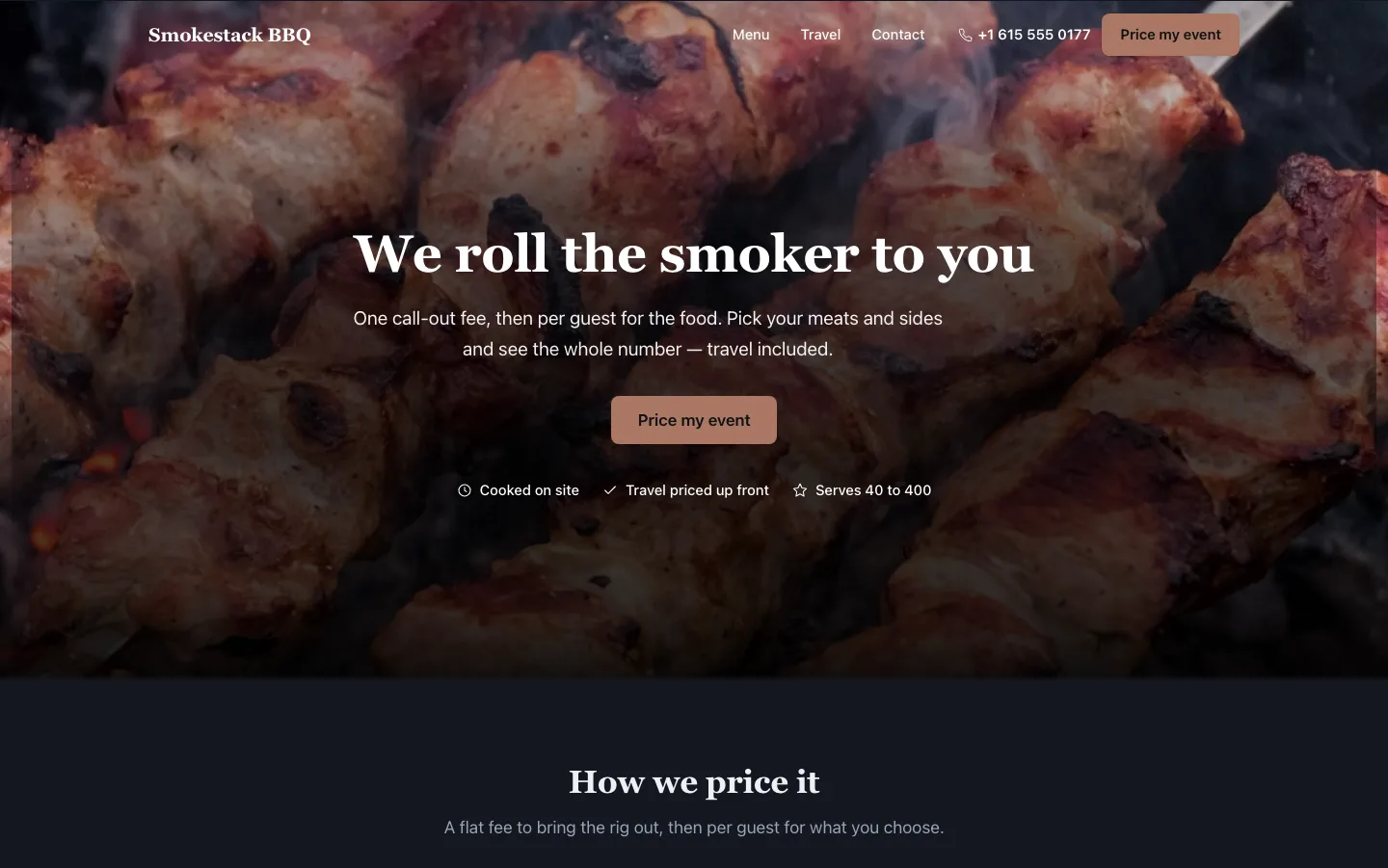
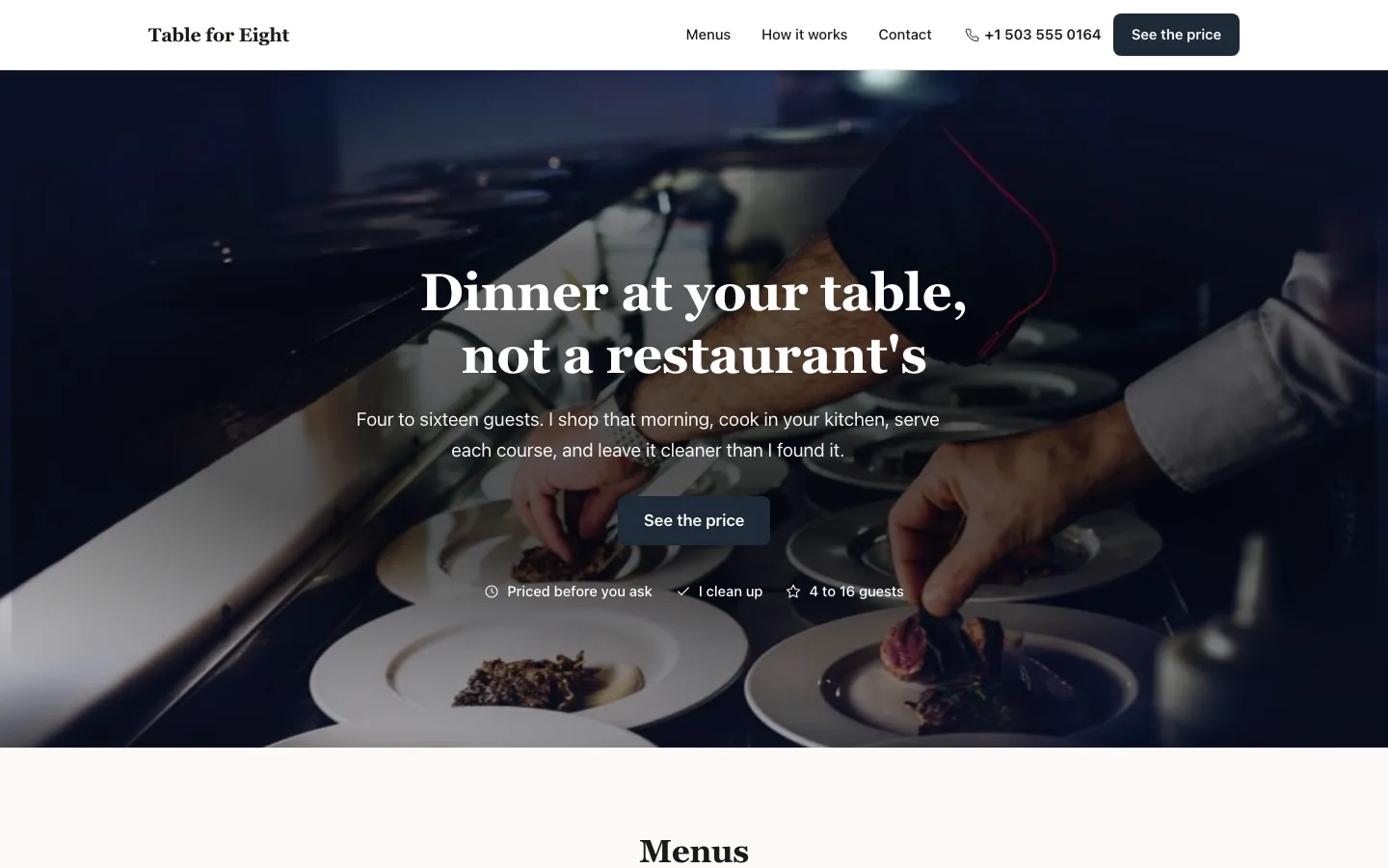
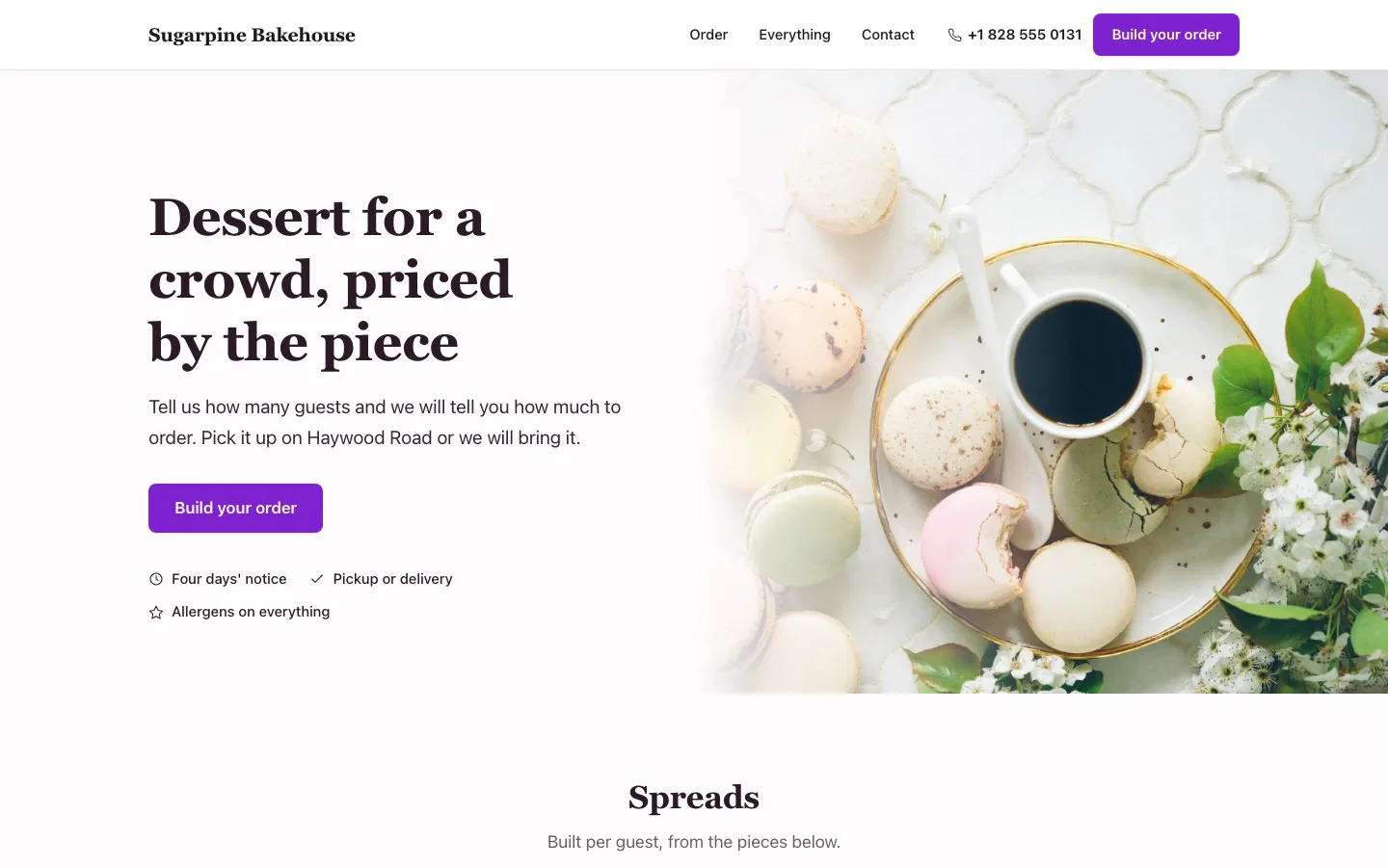
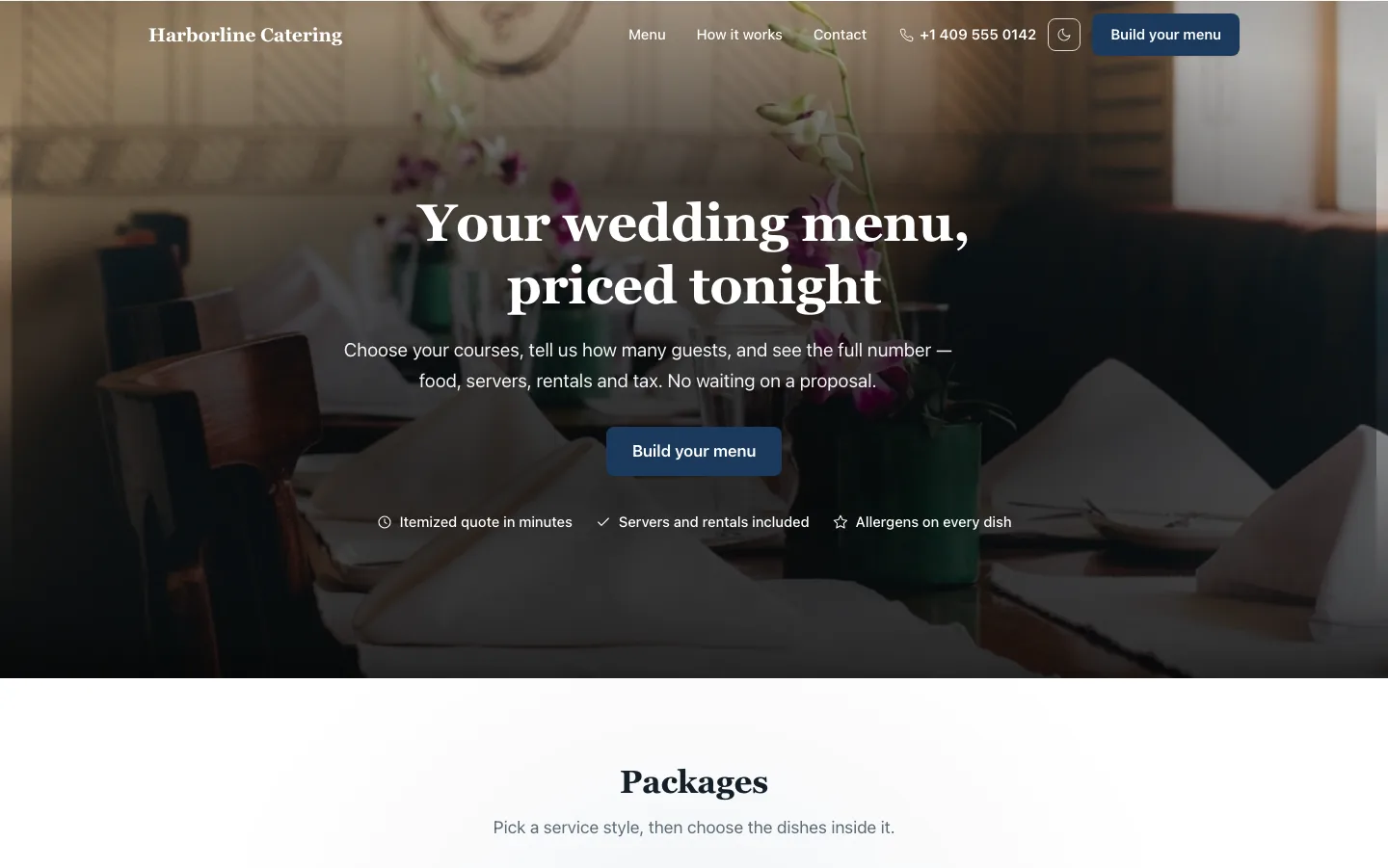
Somebody needs to feed forty people a week on Thursday, and they are looking at nine in the evening. Right now they fill in your contact form and wait — a day for a reply, a week and a half for a quote, and two rounds of email to change the dessert. We build the website for your kitchen, on your own domain, with your own payment account, where they pick the menu themselves, watch the price move as they click, and leave with a quote as a PDF and an order already on your list.

Nothing to install and nothing to fill in first. Below are five real websites, each one a different kind of kitchen, and a dashboard you can click around in right now.

Five caterers, five websites

This is what you get

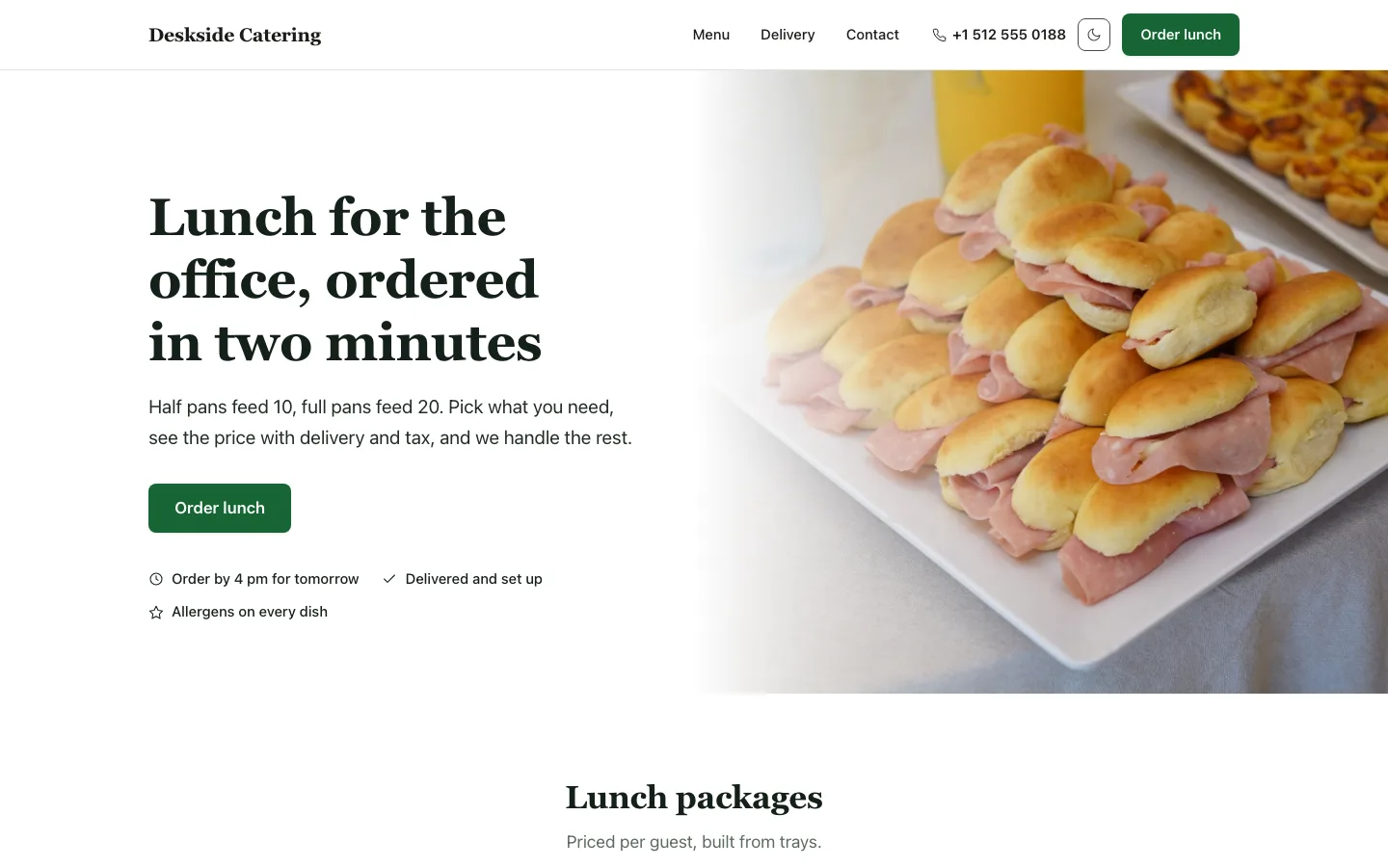
Every one of these is a working website with its own domain, its own look and its own pricing. None of them share a template — a barbecue truck should not look like a wedding caterer. Open any of them, build a menu and get a quote as if you were a customer; nothing you do there reaches anyone.

And the side they never show you

Open the dashboard and change something

Every demo above is run from a dashboard. Click below and you get your own copy of one — not a video, not a walkthrough. Change the headline, the colours, the prices, add a dish, put an allergen on it, and watch the site change next to you. No signup, no card, nothing to install. It is yours for two hours and then it deletes itself.

Open the dashboard

Opens in a few seconds. Nothing you do there is saved or seen by anyone.

The same request, two routes

9:12pm on a Tuesday

An office manager has been told to feed forty people next Thursday. She has three tabs open and she is going to finish this tonight.

A contact form and a quote written by hand

She finds you on Google9:12pm
Fills in “tell us about your event”9:16pm
You read itnext morning
You call to ask what she wantsday two
You write the quote in a spreadsheetday four
She swapped the dessert; you rewrite itday six
She booked the kitchen that answered on Tuesday night
Events booked0

Nothing was lost through a fee. It was lost in the gap between the question and the price.

Your own website

She finds you on Google9:12pm
Picks the package, forty guests, two mains9:15pm
Price on screen, moving as she clicks9:15pm
Flags two gluten and one shellfish allergy9:17pm
Downloads the quote as a PDF for her boss9:18pm
Order on your list, deposit taken9:19pm
Events booked1

The deposit goes to your own Stripe account. It never passes through us, and we take no percentage of it.

The seven minutes are not the point. The evening is. The person deciding is doing it after hours, with a number she has to justify to somebody else in the morning — and she cannot justify a number she does not have yet.

The second argument is arithmetic rather than timing, and it only applies if you sell through a marketplace: a commission is charged on every order, forever, while our fee is the same whether you sell nothing this month or half a million. Put your own volume, your own commission rate and your own average order into the calculator and it works out the difference — our fee subtracted, no invented averages. For a kitchen with little marketplace volume it comes out against us, and it says so.

What you get

A website that also writes the quote

Most booking software knows appointments. Catering Deck is not appointments: it is a menu with choices inside it, a headcount that changes twice before the day, and a price that depends on all of it at once.

A menu the customer builds

Packages with “pick two of these five”, sizes, upgrades that cost more, extras on the side. Every click moves the price on the screen in front of them, before anyone has emailed anyone.

Priced whichever way you price

Per person, per tray, per piece, a flat fee to bring the truck out, or a rate that goes up as the table gets smaller. Tiers by headcount in either direction, minimums that top an order up rather than turn it away.

A quote as a PDF, in your name

Itemised the way an accounts department needs it — food, staff, rentals, delivery and tax on their own lines. It carries your name and nothing of ours, and it is the thing she forwards to her boss.

Service charge and gratuity kept apart

They are not the same thing and several states are explicit that a mandatory service charge is not a tip. Both are separate lines with their own wording, so a customer never has to ask which one the staff actually receives.

Allergens on every single item

The nine federal allergens plus gluten, marked per dish, not typed into a notes box. A customer who filters for shellfish sees a menu that has already removed it — and an unmarked dish is never treated as safe.

Sales tax the way your state does it

Three separate questions, because they have three separate answers: is the food taxed, is delivery taxed, is a mandatory service charge taxed. Set once, applied per line, shown on the quote.

Delivery zones and a travel charge

By zone or by the mile past a radius you set, each with its own minimum. An address outside every zone is told so on the spot instead of being quoted and then disappointed.

The final headcount, chased for you

A guarantee date counted in working days, and a reminder that keeps arriving until the number is confirmed. You bill the greater of what was guaranteed and what was served, which is how this trade has always worked.

Deposits, balances and CSV out

A deposit on booking and the balance when you say, on your own Stripe account. Customers, orders, quotes and menus export to CSV whenever you want, without asking us.

A prep sheet the kitchen can work from

One page for the week: how much of every dish across all the orders, the dietary counts in a line of their own, then order by order with the address, the time, what to load and what the customer wrote. Print it and put it on the wall.

Mandatory fees, said where the price is

Service charge, gratuity and delivery are printed next to the price on the menu, with what the service charge is for — not discovered in the total at the end. Four states now require that in writing, and it is the right thing to do anyway.

How it works

You approve it before anything is yours to pay for

  1. Step 1

    We build a demo of your kitchen

    From what is already public: your name, your menu, your prices, the area you serve. You look at a working website with your own dishes on it, not a slide deck. This costs you nothing and commits you to nothing.

  2. Step 2

    You tell us what is wrong with it

    The prices we read off a PDF from 2023, the package that no longer exists, the minimum you actually hold people to, how far you will drive. Two rounds of changes, and in practice it is usually one.

  3. Step 3

    Domain and payment account, in your name

    You buy the domain, you open the Stripe account. Both are yours from the first minute, which is the whole point — see below.

  4. Step 4

    It goes live, and we keep it running

    Hosting, updates, backups, security. Changes and support the same business day — and the menu you change yourself, in the dashboard, in the time it takes to read this.

What is yours

If you leave, you take it with you

Every part of this that matters is registered in your name, not ours. That is not generosity — it is the only arrangement that makes the rest of the promises believable.

Your domain

yourkitchen.com

Bought on your card, in your name, at a registrar you choose. We configure it. If you leave, you point it somewhere else and nothing of yours moves.

Your payment account

Stripe, in your name

Customers pay you. The deposit and the balance land in your Stripe balance and go to your bank. It never passes through an account of ours, and there is no technical route by which it could.

Your menu and your customers

Export any time

Dishes, prices, packages, customers, orders and quotes — all of it exports to CSV whenever you want, without asking us.

Not a listing on our site

yourkitchen.com, not us/yourkitchen

We are not a marketplace, we do not sell you leads, and we do not put you next to four competitors sorted by price. The whole argument of this page is that the order should arrive without anyone standing between you and it.

Pricing

One price, however much you sell

No commission, no charge per quote, no bands. The two things this trade is normally billed on are the two things you are trying to do more of — send quotes and take orders — and we are not going to charge you for trying.

$0

No setup fee. The demo with your own menu on it exists before we contact you, and the design, the loading of your dishes and prices, the domain and payment account, and two rounds of changes are all in the monthly fee. There is nothing to pay before the site is live and nothing to pay if you decide against it.

$59 a month, or $708 for a year — the same money, whichever suits your bookkeeping. It does not change with how much you sell, how many quotes you send or how many events you run, and there is no minimum term: if you leave, we invoice up to the current month. Prices are in US dollars and are what you are invoiced: we add no sales tax and no VAT. The domain (about $12 a year) you pay directly to the registrar, in your own name. Stripe's processing fees are charged by Stripe and never pass through us.

What we do not sell

This does not run your kitchen

Four things in this trade are each an entire product of their own, and half of one is worse than none. We are not going to pretend an ordering website is any of them, because the first time it wasn't you would be the one holding it.

Not included

Recipe costing and food cost percentages, inventory and purchasing, staff scheduling and payroll, delivery routing, and SMS.

What we do instead

Everything the site records — every order, every quote, every customer, every line of every menu — exports to CSV whenever you want. Whatever you use for costing or for the rota, you feed it from that instead of typing it twice.

Why we say it here

Because it comes up in almost every conversation, and it is a much better answer before you have paid us than after.

What else you could do

Three honest options

We are not the only way to solve this, and one of the three may well be the right answer for you. Here is when.

A marketplace listing

The ordering sites that corporate buyers already have accounts with. Real demand, no work to set up, and an order arrives without you doing anything.

Where it stops: a percentage of every order, forever, including from the office that would have called you anyway; you do not get the customer, you get the order; and the price you show is next to four competitors sorted by it.

Right answer if: you have spare capacity, no name in your city yet, and you would rather pay for demand than build it. Most kitchens should be on one and have their own site.

Catering Deck management software

Built for this trade and it goes much further than we do: recipe costing, inventory, staff scheduling, banquet event orders, multi‑venue reporting.

Where it stops: it does not build you a website, so the customer still has to reach you before any of it starts; and the pricing is usually per user or per quote, which is a charge on selling.

Right answer if: food cost and the rota are your real problem, and you already have a website that brings the orders in.

Us

A website with your brand on it where the customer builds the menu and leaves with a priced quote, for $59/month, flat, with no setup fee and no commission. Packages, allergens, tax, delivery, deposits, CSV out.

Where it stops: costing, inventory, payroll and routing — we say so above.

Right answer if: people ask you for a price and it takes you days to give them one.

We have deliberately left prices off the other two columns. Their pricing changes, ours would be second‑hand by the time you read it, and a competitor's number quoted wrong is the fastest way to lose your trust. Look them up — if one of them fits you better, take it. The calculator compares us against the first column with your own numbers, and it does not always come out our way.

What the subscription covers

The part nobody quotes for

A website is not a thing you buy once. Most of what goes wrong with one goes wrong quietly, months later.

Hosting and speedServed from the data centre nearest the person looking at it. No server for you to worry about, and nothing to renew.
Updates and securityPatched as part of the platform, not as a project you have to approve.
BackupsEvery published version kept, so a bad edit is undone rather than rebuilt.
ChangesA new dish, a price rise, a package retired for the summer, a day you will not work — you do those yourself in the dashboard. If you would rather we did it, we do it.
Email that arrivesQuotes, confirmations and reminders sent from your own domain, set up so they land in the inbox instead of spam.

Questions

The ones that come up every time

Do you take a cut of the orders?
No, and there is no technical route by which we could. Customers pay into your Stripe account directly, you are the merchant of record, and the money does not pass through us for a second. We invoice you a fixed amount and that is the entire commercial relationship.
Does the price go up as we sell more?
No. It is $59 a month at eighty thousand a year and $59 a month at eight hundred thousand, and it does not move with the number of quotes you send. The two common ways of billing this trade — a percentage of the order and a charge per quote — both bill you for trying to sell, which is a strange thing to charge for.
Our prices are complicated. Half the time we quote by hand anyway.
Then say so on the site and let the customer build the order without a price on it — you can run any menu as an enquiry, as a quote you send back, or as an order they pay for on the spot, and you can mix the three. What you get either way is a request that already says what they want, for how many, on what date, instead of “tell us about your event”.
What about sales tax? It is different in every state.
It is three separate questions and we ask all three: whether prepared food is taxed, whether delivery is taxed, and whether a mandatory service charge is taxed. Set them once and every line of every quote follows. We are not your accountant, and the answers are yours to confirm — but the site will not quietly get it wrong on one line and right on another.
Is the service charge a tip?
Not unless you say it is, and the site keeps them as two different lines with two different explanations. Several states are explicit that a mandatory service charge belongs to the business rather than the staff, and a customer who is not told which is which will assume the wrong one. This is the single most common way a caterer ends up in an argument on the day.
What happens when the headcount changes?
It always does. You set a guarantee date — counted in working days before the event, so a Saturday wedding does not have a Sunday deadline — and the site chases the final number until it has it. After that date the count can go up but not down, and you bill the greater of what was guaranteed and what was served.
Allergies. How much of that is on us?
All of it, and that does not change. What the site does is make it a marked field on each dish rather than a sentence typed in a notes box, so a customer filtering for shellfish sees a menu with the shellfish gone, and the order carries the allergy through to the kitchen sheet. A dish you have not marked is never shown as safe.
Can you move our menu across from what we use now?
The menu, yes — that is the demo, and it exists before we talk. Past orders and quotes in another system stay where they are; we are not going to promise a migration we have not built, because moving records is the thing that goes wrong quietly.
What happens if I stop paying?
The website stops being served and your data exports to CSV. The domain and the Stripe account are yours and are untouched, because they were never ours. You point the domain somewhere else and nothing of yours moves.
How long until it is live?
The demo already exists before we contact you. From your first reply, live usually takes a few days — most of which is waiting on the domain and on Stripe verifying you, neither of which we can do for you.
Get in touch

We'll build a demo of your kitchen

Send us your current website, or just your Google listing and a menu PDF, and we'll build a demo with your own dishes, your own prices and your own packages, so you can see how it would look before deciding anything. No commitment and no cost.